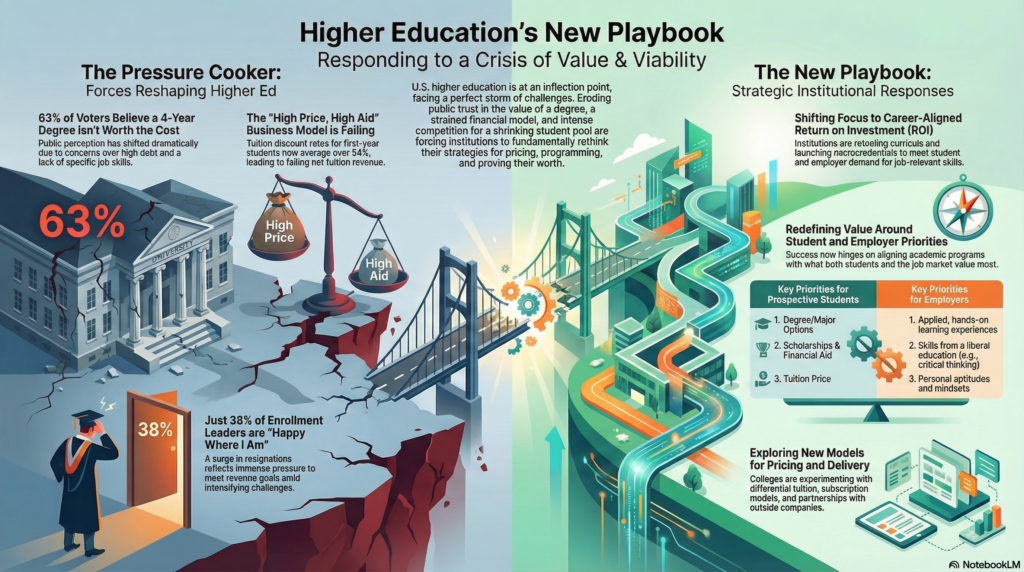
Private colleges and universities face unprecedented challenges. The demographic cliff isn’t coming; it’s here. Public skepticism about higher education’s value is real. The business model seems broken. Competition for students has never been more fierce. Yet these institutions represent something irreplaceable in American higher education—places that foster intellectual curiosity, develop character, build lasting communities, and prepare students for lives of purpose and leadership. We offer the skills that employers say they most want – critical thinking, communications, teamwork, adaptability, leadership.
The question isn’t whether private colleges will survive. The question is whether they’ll adapt.
Six Principles for Sustainable Enrollment
Enrollment strategy is the institutional strategy. Too many colleges treat enrollment as a technical function—something delegated to admissions staff while leadership focuses elsewhere. This is a mistake. Enrollment health is institutional health. Presidents and boards who understand this lead institutions that thrive.
Silos are the enemy. The institutions that succeed integrate enrollment strategy across admissions, financial aid, communications, academic affairs, student success, athletics, and advancement. When these functions operate independently, they undermine each other. When they work in concert, they amplify results.
Data informs, but judgment decides. Data alone doesn’t make strategy. Successful institutions combine rigorous analysis with strategic judgment, institutional knowledge, and the courage to act.
Mission matters…vision matters more. Every private college has a mission. Enrollment strategies that work are those aligned with who you are—not imitations of what works elsewhere. Finding competitive advantage within authentic identity is what separates thriving institutions from struggling ones.
Net revenue is the key. Application or headcount growth isn’t success if it erodes net revenue—it’s a warning sign. Sustainable enrollment strategy must protect and grow the revenue an institution needs to fulfill its mission.
The landscape has changed—permanently. Institutions that succeed will be those that adapt, not those waiting for conditions to improve. This requires facing hard truths and building strategies accordingly.
What This Means for Leadership
The colleges navigating this moment successfully share common characteristics. They treat enrollment as an enterprise-wide priority, not a departmental responsibility. They make decisions grounded in comprehensive data while recognizing that analysis without judgment leads nowhere. They work across traditional organizational boundaries and make strategic decisions to support enrollment.
Most importantly, they’re honest about the challenges ahead. The institutions that will thrive aren’t necessarily those with the most resources or the strongest brands. They’re the ones willing to rethink their approach while staying true to their mission.
J. Carey Thompson is the founder of CVET Enrollment Strategies, bringing 35+ years of senior enrollment leadership experience across admission, financial aid, career services, communications, athletics, and institutional research. CVET partners with private colleges and universities to develop comprehensive, evidence-based enrollment strategies. Learn more at cvetconsulting.com.